
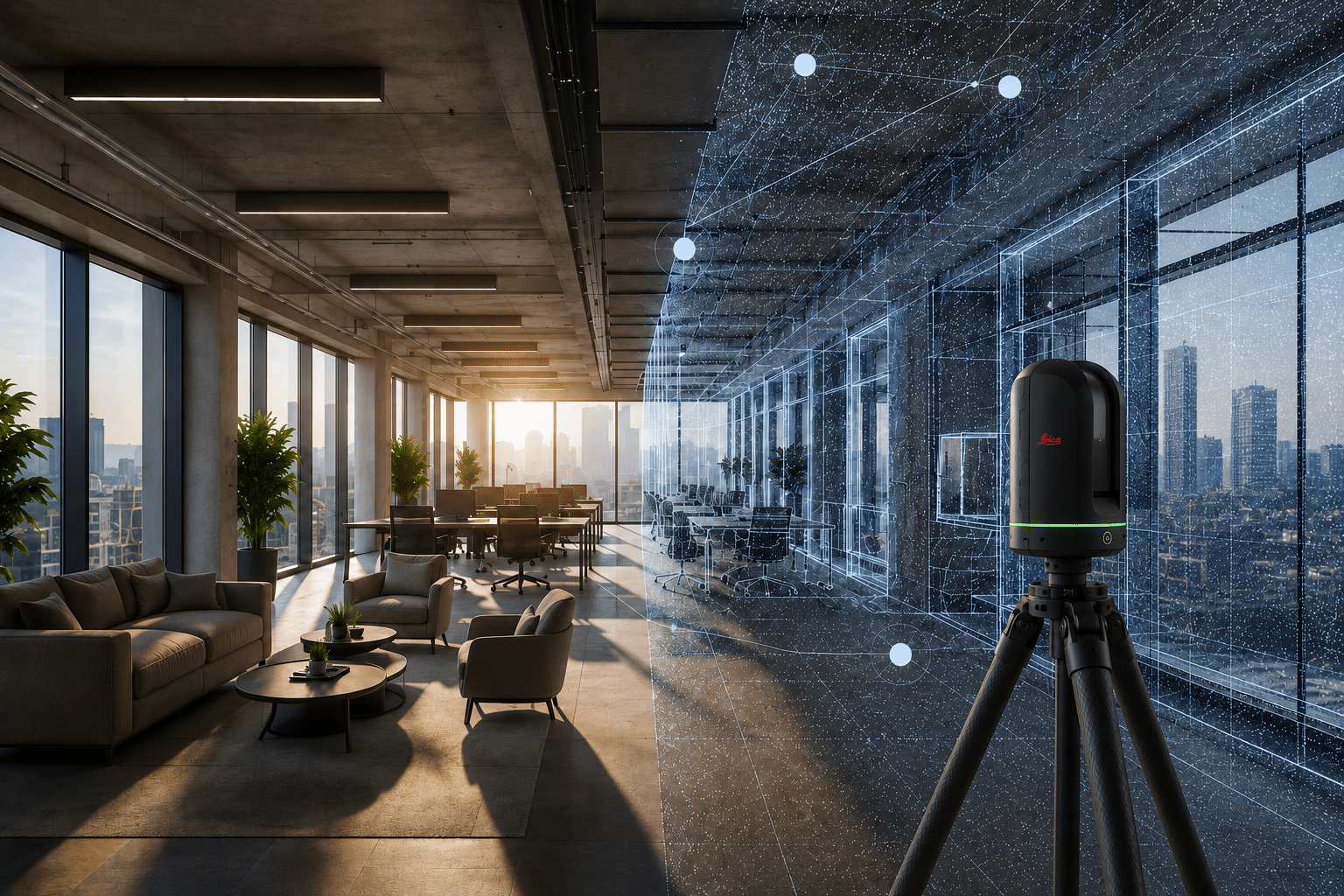
For decades, floor plans, photography, and property brochures have served a singular purpose in real estate: representation. They were static marketing tools designed to communicate space, showcase aesthetics, and support transactions.
Today, that role is changing rapidly.
As the built environment becomes increasingly digitised, visual property data is evolving from a marketing asset into a strategic intelligence layer, one capable of informing valuation, operational performance, ESG reporting, compliance, and long-term asset strategy.
At Digital Reality Corp, we believe the future of real estate lies not just in how buildings are designed or managed, but in how accurately they are understood through verified spatial intelligence. Through platforms like Spatial-IQ, this intelligence becomes accessible, interactive, and actionable at portfolio scale.
The Majority of Real Estate Still Exists Offline
Despite rapid advances in proptech and digital transformation, most of the world’s buildings still lack verified digital records.
There are more than four billion residential and commercial buildings globally, yet the vast majority remain undigitised, measured inconsistently, or managed through fragmented documentation. Drawings become outdated, operational data is siloed, and critical building intelligence is often buried in disconnected PDFs, spreadsheets, and static reports.
As real estate increasingly operates as a digital marketplace, this creates a growing challenge: decision-makers are relying on incomplete or unverified information to manage some of the world’s most valuable assets.
The opportunity lies in creating universal accuracy and consistency across the built environment, transforming buildings into structured digital assets that unlock efficiency, sustainability, and long-term value.
From Visualisation to Intelligence
Modern surveying technologies, including lidar scanning, digital twins, and AI-powered annotation, are redefining what visual data can achieve.
- A floor plan is no longer simply a diagram.
- A photograph is no longer just imagery.
- A 3D model is no longer just a design tool.
Together, they form a connected digital ecosystem capable of delivering measurable business intelligence across the property lifecycle.
At the heart of this transformation is verified point-cloud data, a precise digital representation of physical space captured through advanced scanning technologies. Unlike traditional surveying methods, point-cloud data creates a single source of truth from which multiple deliverables can be generated, including:
- RICS & IPMS-compliant measurement reports
- 2D CAD drawings
- 3D BIM models
- Digital twins
- Compliance-ready documentation
- Interactive marketing assets
But the true value emerges when this information becomes connected, queryable, and continuously accessible.
Spatial-IQ: Turning Building Data into Portfolio Intelligence
Spatial-IQ was developed to bridge the gap between static building documentation and live portfolio intelligence.
Built on verified measured survey data, Spatial-IQ transforms fragmented building information into a dynamic, interactive platform for understanding, managing, and optimising assets at scale. Rather than treating surveys as isolated deliverables, Spatial-IQ creates a connected digital environment where stakeholders can interact with accurate building intelligence in real time.
This allows owners, investors, asset managers, and operational teams to move beyond static files and toward a living digital record of their assets.
Through Spatial-IQ, users can:
- Access verified floor plans, imagery, and spatial data through a centralised platform
- Visualise assets using interactive digital twins and annotated imagery
- Improve collaboration across property, facilities, design, and compliance teams
- Track asset conditions and operational information more effectively
- Support ESG initiatives through accurate, measurable building data
- Reduce inefficiencies caused by disconnected or outdated records
In essence, Spatial-IQ transforms building information from passive documentation into active operational intelligence.
The Convergence of Marketing, Operations, and Analytics
One of the most significant shifts happening in real estate is the convergence between marketing data and operational data.
Digital brochures, immersive walkthroughs, and interactive floor plans were once designed purely for leasing and marketing purposes. Increasingly, however, these same assets are being repurposed to support broader business functions, including:
Asset Valuation
Verified spatial intelligence improves confidence in area measurements, rentable spaces, and occupancy analysis. Accurate measurements reduce discrepancies that directly impact valuations and leasing decisions.
ESG & Sustainability Reporting
As environmental reporting standards become stricter, owners require measurable data around occupancy, spatial efficiency, and building performance. Digital twins and verified models provide the foundation for credible ESG reporting.
Facilities & Operations Management
Interactive visual data enables facility managers to better understand circulation, maintenance requirements, fire routes, infrastructure systems, and tenant-specific operational needs.
Compliance & Risk Mitigation
Verified digital records help organisations maintain audit-ready documentation while reducing risks associated with outdated or inaccurate building information.
Portfolio Optimisation
For institutional investors and multi-site operators, platforms like Spatial-IQ enable portfolio-wide visibility, standardisation, and benchmarking across assets and geographies.
Why Verification Matters
As buildings become increasingly data-driven, the integrity of that data becomes critical.
A visually impressive model means little if the underlying measurements are inconsistent or unverifiable. Inaccurate data can lead to valuation disputes, operational inefficiencies, compliance risks, and costly redesigns.
At DRC, every deliverable is built from verified point-cloud data and supported by proprietary software, AI-assisted workflows, and rigorous quality control processes. Our technology enables continuous annotation, validation, and refinement of building intelligence at scale, while maintaining the precision required for high-value real estate decisions.
The Rise of the Intelligent Building Record
The industry is moving toward a future where every building will have a continuously evolving digital record, not simply a collection of drawings or photographs, but a living ecosystem of spatial intelligence.
This intelligent building record will combine:
- Spatial geometry
- Operational data
- Compliance information
- Asset condition
- Sustainability metrics
- Historical changes
- Real-time insights
In many ways, buildings are beginning to function more like software: dynamic, measurable, interconnected, and continuously updated.
The organisations investing early in verified digital infrastructure will be best positioned to unlock operational efficiencies, reduce risk, improve sustainability outcomes, and maximise long-term asset value.
Beyond the Floor Plan
The future of real estate intelligence will not be defined by visuals alone, but by the ability to transform visual data into actionable insight.
Floor plans, imagery, digital twins, and 3D models are no longer the final output. They are the foundation of a much larger ecosystem, one where verified spatial intelligence powers smarter buildings, stronger portfolios, and better decisions across the built world.
At Digital Reality Corp, and through platforms like Spatial-IQ, we are helping redefine how buildings are captured, verified, and managed, transforming static building records into connected intelligence for the modern real estate industry.